From Energy Consumer to Circular Contributor
Rethinking Sustainable Data Centres
The idea for this article began with a wave of troubling headlines and social media posts about data centres.
In New South Wales, councils have urged the State Government to pause new approvals while the cumulative effects of a reported $41 billion development pipeline are better understood. Their concerns include electricity capacity being reserved years before facilities become operational, pressure on drinking-water infrastructure, and competition with housing in well-connected precincts.
These concerns are now being examined by a NSW parliamentary inquiry into data centres. Council submissions have raised issues around grid constraints, water, noise, heat, emissions and neighbourhood amenity. Penrith City Council called for approvals to pause until utility impacts are understood, while the City of Ryde argued that facilities in Macquarie Park were competing with potential housing. The Guardian's reporting captures the debate.
Online, the discussion has become even more emotive. Posts suggest a future in which families cannot turn on their taps because data centres have consumed the available water. These images are rhetoric, not proof that this has occurred, but the anxiety behind them should not be dismissed. They reveal a growing perception that data centres take energy, water and land without giving enough back.
At Louvreclad, that prompted a different question: rather than debating whether data centres should exist, how can we rethink them, so they work harder for the environment and their communities?
AI is now integrated into business and everyday life. Few of us want to give up its potential, but enjoying its benefits does not relieve the industry of responsibility for the infrastructure behind it.
The sustainable data centre should not be an isolated consumer. It should become an active participant in a circular energy, water, material and community system: one that uses less, recovers more and creates value beyond its site boundary.
Start with the fundamentals
Conversations about sustainable data centres often begin with renewable electricity or advanced liquid cooling. These innovations matter, but good performance still starts with the fundamentals.
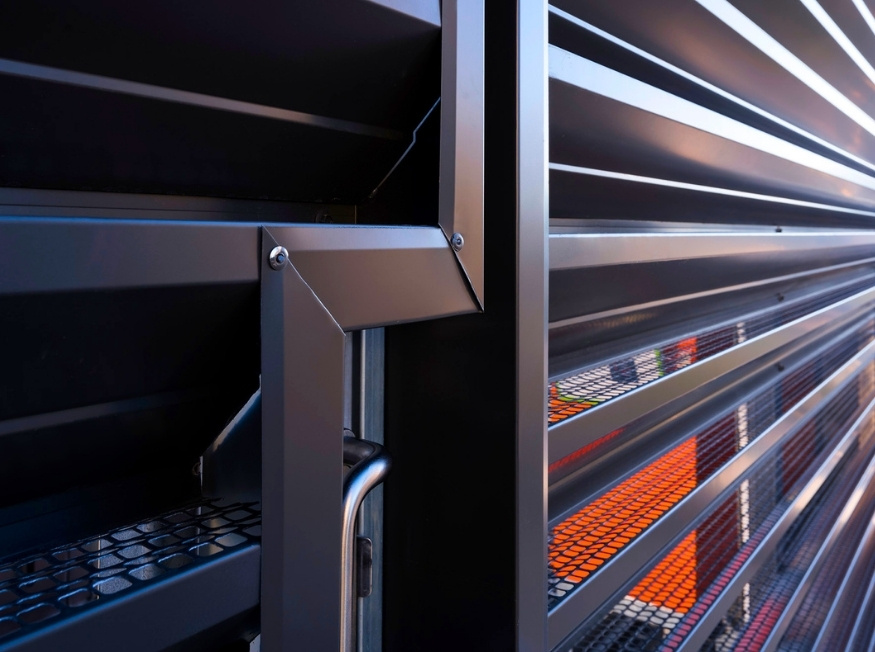
Every component affecting airflow, heat transfer and cooling demand contributes to operational energy use. That includes elements often treated as architectural details rather than mechanical components, particularly the external louvres through which enormous volumes of air must pass.
As Arup observes, data-centre sustainability requires coordinated progress across carbon, energy, water, cost, adaptability and community integration. It is a series of connected lifecycle decisions.
Arup: How can data centres become more sustainable?
High-performance louvres are one of those decisions.
Why aerodynamic performance matters
Louvres create resistance as air passes through them. In data centres, where air-handling systems move large volumes of air continuously, this resistance directly affects fan demand, energy consumption and operating cost. The principle is simple: lower pressure drop means less energy is required to maintain airflow.
Aerodynamic efficiency is expressed through the coefficient of discharge, or Cd. A higher Cd generally indicates more efficient airflow and provides a more meaningful basis for selecting a high-performance louvre system than free-open-area percentages alone.
As the first Australian louvre independently tested and certified to AS 4740:2025, Aerion Series® applies Formula 1-derived aerodynamic principles, including computational fluid dynamics and aerofoil geometry, to support smoother airflow and reduce turbulence. This performance has been verified through third-party testing, achieving Class 1 aerodynamics with a coefficient of discharge (Cd) of 0.81 and Class A rain resistance, while also providing zero-vision screening.
Actual energy savings depend on each facility’s airflow, louvre area, fan efficiency and operating profile. However, integrating a verified high-performance louvre system can reduce avoidable fan energy while protecting critical equipment from wind-driven rain and moisture ingress.
The façade is not decorative screening around the engineering. It is part of the engineering.
Use water responsibly and recover heat

Cooling strategies must respond to climate, computing density and local constraints. There is no universal solution.
Passive airflow, effective hot-and-cold separation and efficient containment should come first. Where liquid cooling is justified for high-density AI workloads, systems can use closed loops, recycled or non-potable water, and hybrid strategies that reduce dependence on drinking-water networks.
Water must also be considered at precinct scale. Operators, utilities, government and communities need a shared view of capacity, housing demand, alternative sources and the cumulative effect of multiple facilities. Public concern requires transparent planning and facilities designed to operate within local limits.
Circular thinking then asks what value can be created from the heat being managed.
According to Arup, approximately 90–95% of the electricity consumed by data-centre IT and cooling systems is ultimately converted into heat. Most is discharged into the environment, yet this stable output could support homes, offices, swimming pools, industry, greenhouses and aquaculture. Arup: Data centres, heat reuse and the future of circular energy systems
Waste heat from an AWS facility supplies much of the heating demand at the Technological University of Dublin's Tallaght campus, while an Equinix facility in Paris supplies approximately 1,000 homes.
Liquid cooling, direct-to-chip systems, closed-loop networks and modular heat pumps are making useful heat easier to capture and export. Heat reuse can improve a facility's Energy Reuse Factor, reduce cooling demand and potentially create a service for surrounding communities.
Data centres can also align workloads with renewable generation, incorporate storage and support the grid where operations allow, moving beyond purchasing renewable electricity towards using it intelligently.
Think circularly across the whole asset
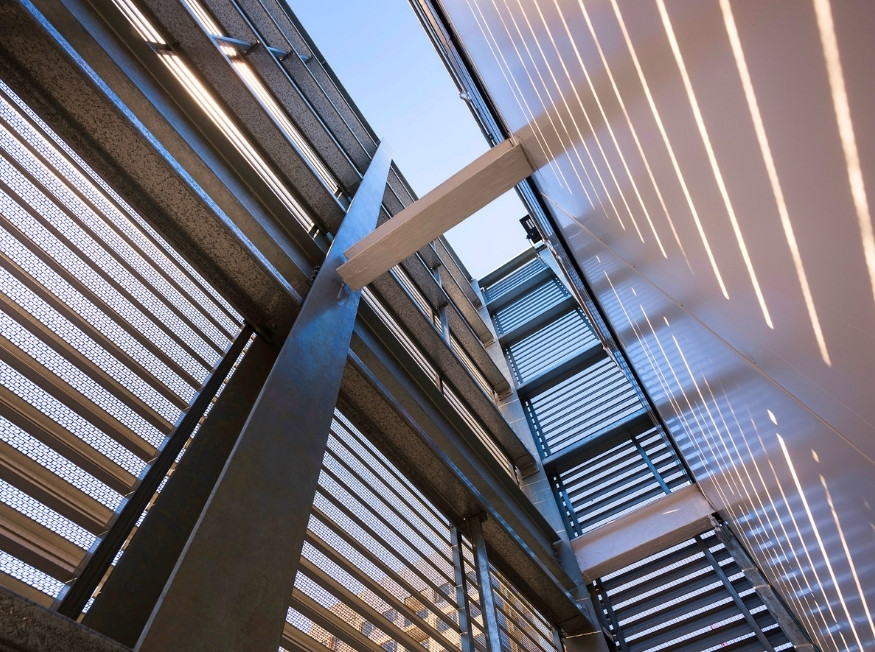
A circular data centre is not defined by heat recovery alone. The approach should extend across its lifecycle: reduce demand through efficient airflow and context-appropriate cooling; source renewable, local or waste-derived energy; recover heat and water; select durable and recyclable materials; design components for maintenance and replacement; adapt existing structures where practical; and plan for disassembly and material recovery.
Modular façade and louvre systems support this approach when designed for long service life, repairability and component-level replacement. Aluminium also has strong circular potential when alloy selection, finishes, fixings and end-of-life recovery are considered from the beginning.
Circularity is not simply a materials declaration. It is a design strategy that keeps energy, water, buildings and components in productive use for as long as possible.
Rethink the façade as a community asset
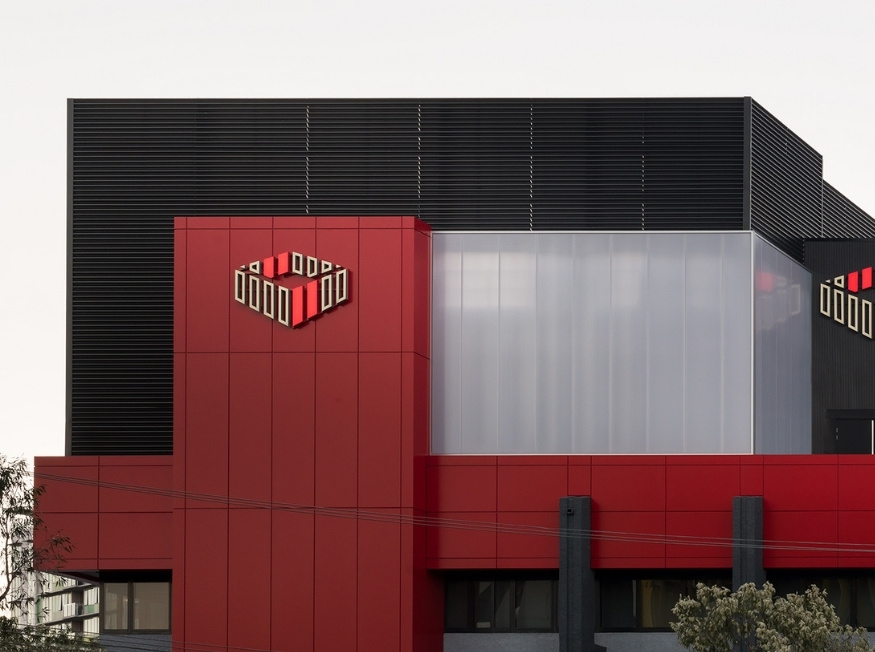
Data-centre façades are commonly treated as defensive envelopes: secure, opaque and anonymous. Security is essential, but it does not require blank infrastructure disconnected from its neighbourhood.
The façade already manages airflow, heat, rain, noise and screening. With early collaboration, it can do more. It can become an integrated urban artwork that contributes identity and visual value to the public realm.
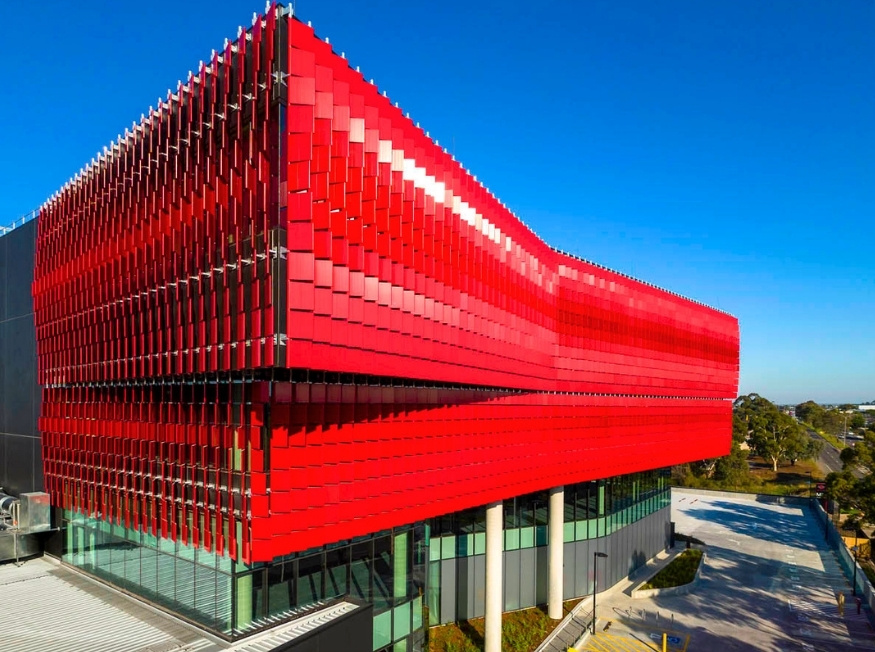
Louvreclad's Chadstone work demonstrates how infrastructure can become a cultural interface. At Chadstone Carpark A – Billow, an artwork conceived by Melbourne artist Matthew Johnson was translated by Jackson Clements Burrows and Cera Stribley into an architectural framework. Working with Vicinity Centres and Hickory Construction, Louvreclad engineered it into a durable, buildable façade without losing its sculptural delicacy.
Across four storeys, 11 kilometres of anodised Platinum Series® fins create a surface that changes with movement and light. The building fabric is the artwork.
At Chadstone's Arboretum, Matthew Johnson, Buchan, Hacer Group and Louvreclad created a permeable Platinum Series® screen across an 850-bay car park. It supports natural ventilation while providing a civic presence. Full-scale prototypes tested against Melbourne wind and storms show that art and verified performance can be developed together.
Imagine applying this thinking to data centres. Façades could incorporate local and First Nations artwork, respond to Country and landscape, or express a facility's circular energy story. Integrated shading, planting and habitat may also be appropriate where climate, maintenance and security permit.
This is not decoration added after the engineering. It is art, architecture, performance and community value designed as one system.
Design data centres that give back
Data centres depend on a social licence to operate. Communities increasingly want to understand not only what a facility will consume, but what it will contribute.
A data centre that lowers fan energy, limits drinking-water use, manages noise, supports the grid, exports recovered heat and enriches the public realm can create tangible local value. Arup describes this as the “good neighbour” approach: development that works for the operator, community and environment.
These outcomes must be considered early. Heat recovery depends on nearby users and infrastructure. Cooling choices affect water demand and the quality of recoverable heat. Louvre selection influences façade area, pressure drop, fan duty and rain defence. Designing with Country and integrated art requires Traditional Custodians, artists and community voices to be involved before the façade is resolved.
The headlines should not be ignored, and the industry's challenges should not be minimised. They should become the brief for doing better.
If we do it properly, the next generation of data centres can provide more than digital capacity. They can consume fewer resources, recover valuable energy, reduce operating costs, enrich the public realm and support the communities around them.
The sustainable data centre of the future will not simply do less harm. It will be designed to give something back.
Design for Better Data Centre Performance
High-performance louvres are one part of a wider approach to designing data centres that use less, recover more and create value beyond their site boundary.
Explore how Louvreclad’s façade and louvre solutions support performance across complex projects.
References
Arup. (2024). How can data centres become more sustainable?
https://www.arup.com/insights/issues/how-can-data-centres-become-more-sustainable/
Arup. (2026). The future of data centres: how is the industry changing in the AI era?
https://www.arup.com/insights/the-future-of-data-centres-how-is-the-industry-changing-in-the-ai-era/
Bynum, J. (2026). Data centres, heat reuse and the future of circular energy systems. Arup.
https://www.arup.com/insights/data-centres-heat-reuse-and-the-future-of-circular-energy-systems/
Louvreclad. (2025). Performance louvres: What is important to the success of your design?
https://www.louvreclad.com/app/uploads/2025/05/Louvreclad-White-Paper_Performance-Louvre_web.pdf
Louvreclad. (2026). Chadstone Carpark A — Billow: An integrated urban artwork, engineered into reality.
https://www.louvreclad.com/projects/chadstone-carpark-a-billow/
Louvreclad. (2026). Aerion Series® project performance analysis: Superior louvre performance and annual operating-cost comparison. Internal project analysis.
New South Wales Parliament. (2026). Inquiry into data centres in New South Wales.
https://www.parliament.nsw.gov.au/parliamentary-business/committees/inquiry-details?committeeInquiryId=3169
Saulwick, J. (2026, April 5). Councils demand NSW hits pause on data centres. Australian Financial Review.
https://www.afr.com/politics/councils-demand-nsw-hits-pause-on-data-centres-20260405-p5zldq
Standards Australia. (2025). AS 4740:2025—Natural ventilators: Classification and performance.
Stock, P. (2026, April 4). Sydney councils fear new data centres could cause blackouts, block housing and affect locals’ health. The Guardian.
https://www.theguardian.com/environment/2026/apr/04/sydney-councils-fear-new-datacentres-could-cause-blackouts-block-housing-and-affect-locals-health